
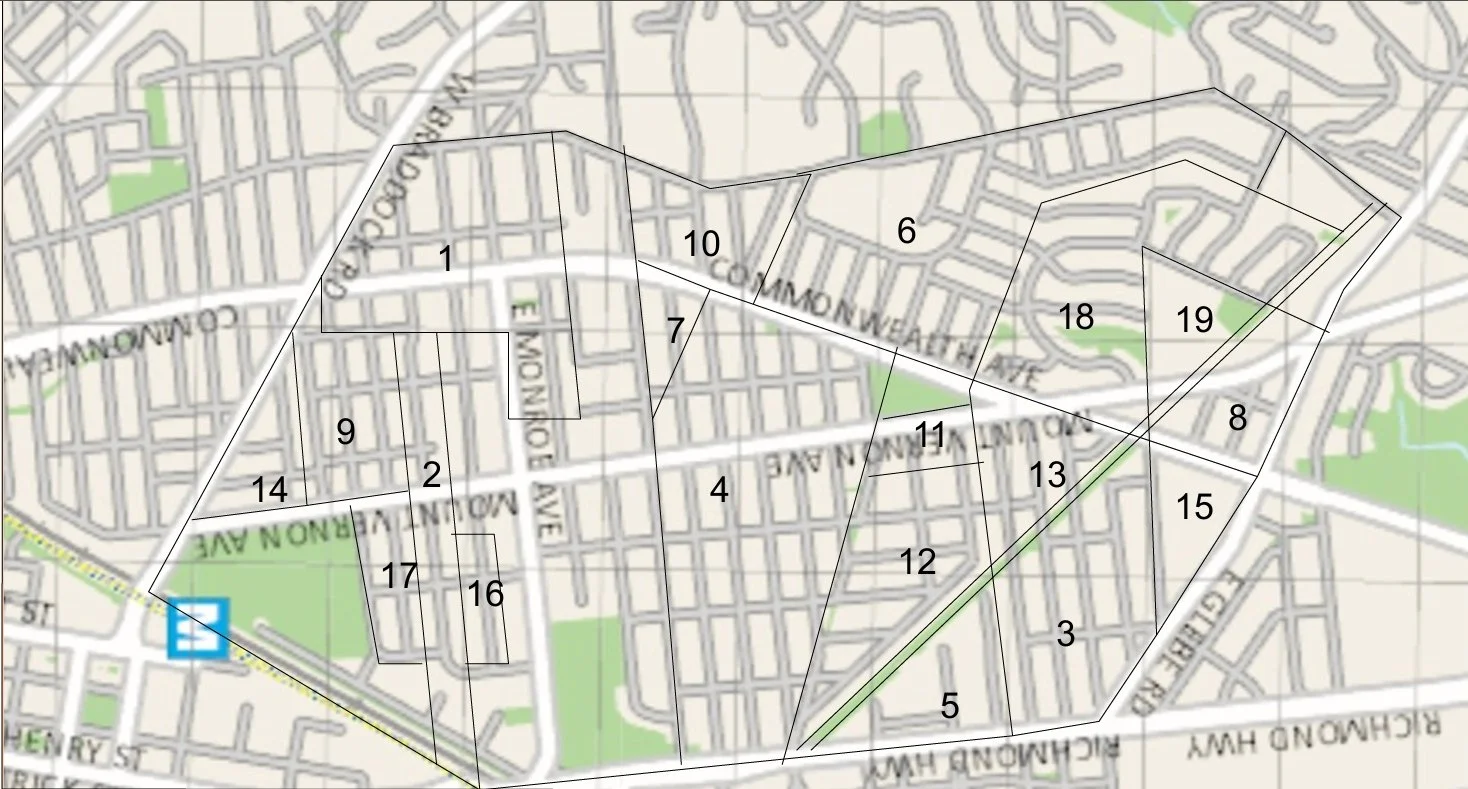
1 = Northwest Alexandria (1890); 2 = Park Addition (1892); 3 = St. Elmo (1894); 4 = Del Ray (1894); 5 = Oakville Triangle (1904); 6 = Mt. Ida (1908); 7 = Del Ray Section 2 (1911); 8 = St. Elmo Section 2 (1920); 9 = Brenton (1920); 10 = Rosecrest (1920); 11 = Mt. Vernon (1921); 12 = Abingdon (1922); 13 = Emma P Hume (1925); 14 = Temple Park Section 2 (1935); 15 = Auburn Village (1939); 16 = Linden Gardens (1939); 17 = Brenton Section 2 (1940); 18 = Warwick Village (1955); 19 = Calvert (1964)
Originally published in the February 2024 edition of Greet Del Ray.
Del Ray is currently recognized as the area bounded by Braddock Road, Russell Road, Glebe Road and Richmond Highway. However, this area consists of various historical real estate developments.
In the 1890s, increases in public transportation spawned a new phenomena: the suburb. Locally, the electric railroad between Washington, D.C. and Alexandria (now Commonwealth Avenue) prompted numerous new suburbs along its path. The first was Northwest Alexandria, which straddled Braddock and Russell Roads (see the October issue of Greet Del Ray). Laid out in 1890, the first portion to be developed was in what is now considered Del Ray. Two years later, Park Addition was added to this development along Alexandria Avenue.
In 1894, Wood, Harmon and Company developed St. Elmo and Del Ray (see the April issue), adding additions to the original area in the 1910s. These communities formed the Town of Potomac in 1908. In the first decade of the 1900s, some of the large estates were broken up. The Swann family sold off their Oakville estate to begin a residential development at Oakville triangle (see the August issue). This was subsequently abandoned and turned into an industrial park. In 1908, the heirs of John Lloyd sold off the Mt. Ida estate to create a new residential development (see the June issue).
Initially, these developments got a slow start, and large areas of vacant land remained. With the advent of public water and sewer lines in the early 1920s, the pace of movement to the suburbs increased thanks to indoor plumbing. The old racetrack was turned into the Mt. Vernon and Abingdon developments (see the September issue). The Brenton and Rosecrest developments on the west and south side of modern Del Ray were created around 1920, Emma P. Hume sold off part of the Warwick estate for another development next to St. Elmo. Numerous smaller land owners south of Bellefonte Avenue sold off individual lots as well.
World War II brought more developments in the vacant spaces on the southern edge of modern Del Ray with the Linden Gardens and Section 2 of both Temple Park and Brenton. Auburn Village was also constructed on land sold by the heir of Thomas Swann. As the last of the millionaire mansions on the western ridge of Del Ray were abandoned (see the December issue), some of the final developments were constructed. The Warwick estate became Warwick Village in 1955, and the Mt. Auburn estate became the Aspen and Calvert Apartments in the 1960s.