The Mamas, The Papas and The Doors

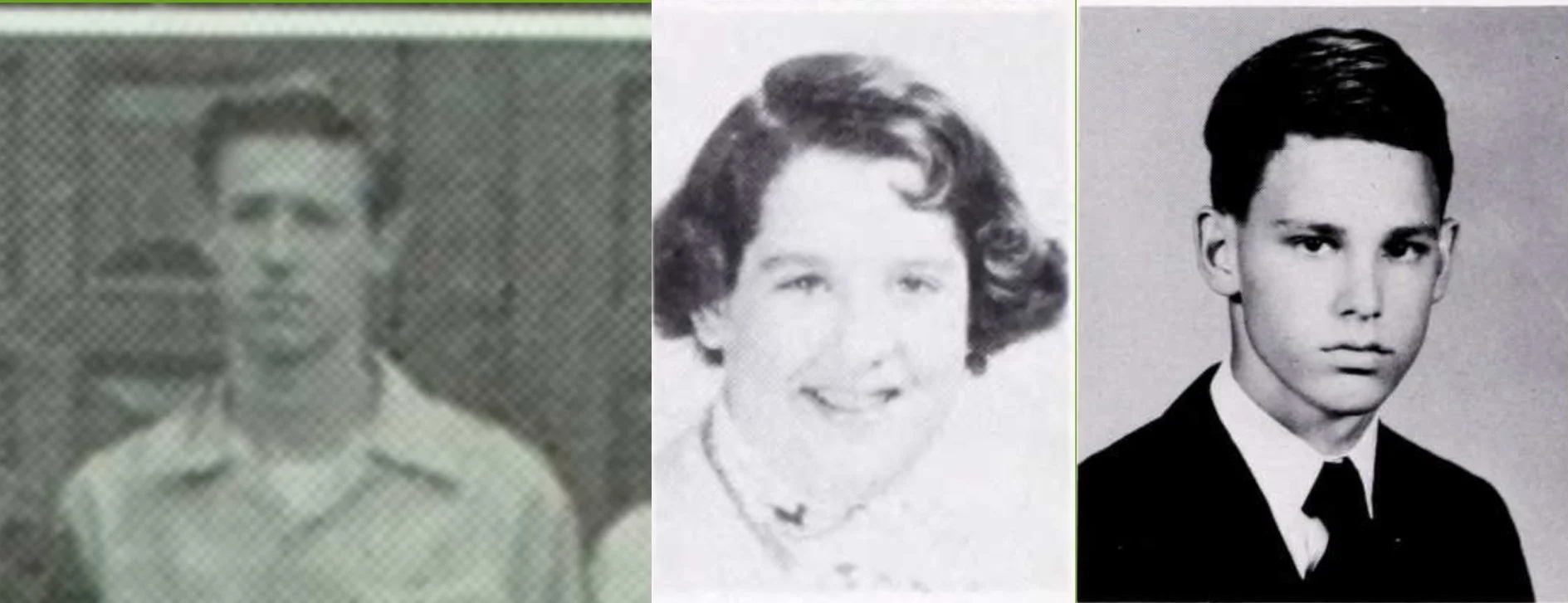
John Phillips in 1953, Cass Elliot in 1955 and Jim Morrison in 1961. This blog makes fair use of copyrighted materials for educational purposes. Resale and further distribution for commercial purposes is not authorized by the author without obtaining appropriate copyright release.


Originally published in the April 2024 edition of Greet Del Ray.

Alexandria has been home to a variety of famous people due to its proximity to Washington, D.C. In the case of Del Ray, a few famous musicians grew up in our area, which has become a bit of local lore.

The most famous is arguably Jim Morrison of The Doors. Morrison was the son of a Navy admiral who lived just outside of Del Ray on Woodland Terrace in the Jefferson Park neighborhood. Morrison spent his high school years from 1959-1961 going to George Washington High School (now the middle school). The mural on the side of St. Elmo's Coffee Pub pays tribute to him.

One of Morrison's classmates at G.W. High School was Cass Elliott of The Mamas & The Papas. Her family lived at Lacy Court on Commonwealth Ave until she was 15. Her father moved to Baltimore at that point, and she graduated from high school there. Prior to their move, she began attending G.W. High School in the same class with Jim Morrison.

Elliott's bandmate John Phillips was also a former Del Ray resident. Phillips grew up on E. Oxford Avenue and also attended G.W. High School, graduating in 1953. He formed his first successful band, The Journeymen, with his friend Scott McKenzie. McKenzie also attended high school in Del Ray, graduating from St. Stephens in 1957.

Other famous musicians who called Del Ray home include Mary Chapin Carpenter, who spent part of her life on E. Bellefonte Ave, and the Celtic band Scythian, which was formed in the basement of a house on Russell Road.
Suburban Alexandria

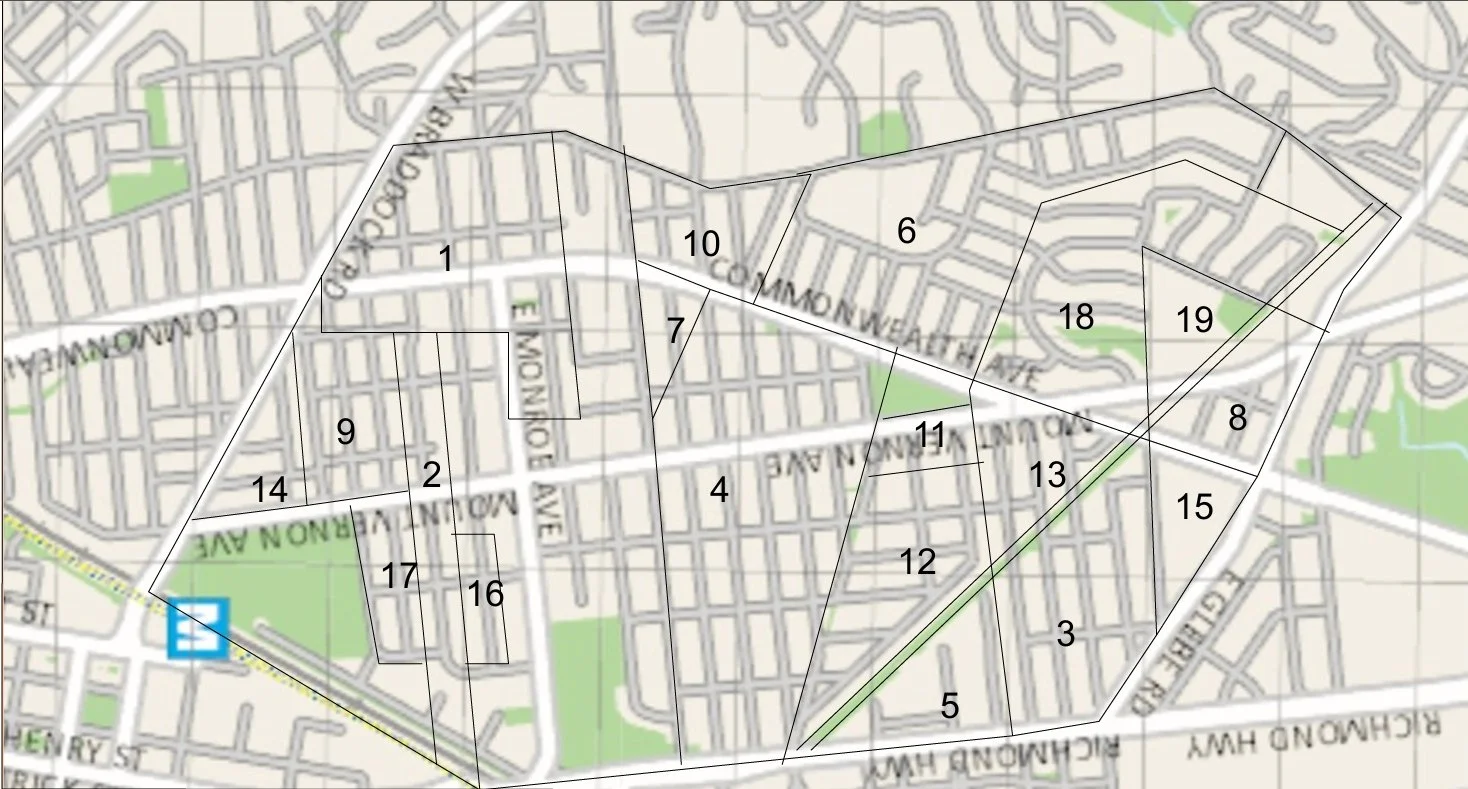
1 = Northwest Alexandria (1890); 2 = Park Addition (1892); 3 = St. Elmo (1894); 4 = Del Ray (1894); 5 = Oakville Triangle (1904); 6 = Mt. Ida (1908); 7 = Del Ray Section 2 (1911); 8 = St. Elmo Section 2 (1920); 9 = Brenton (1920); 10 = Rosecrest (1920); 11 = Mt. Vernon (1921); 12 = Abingdon (1922); 13 = Emma P Hume (1925); 14 = Temple Park Section 2 (1935); 15 = Auburn Village (1939); 16 = Linden Gardens (1939); 17 = Brenton Section 2 (1940); 18 = Warwick Village (1955); 19 = Calvert (1964)

Originally published in the February 2024 edition of Greet Del Ray.

Del Ray is currently recognized as the area bounded by Braddock Road, Russell Road, Glebe Road and Richmond Highway. However, this area consists of various historical real estate developments.

In the 1890s, increases in public transportation spawned a new phenomena: the suburb. Locally, the electric railroad between Washington, D.C. and Alexandria (now Commonwealth Avenue) prompted numerous new suburbs along its path. The first was Northwest Alexandria, which straddled Braddock and Russell Roads (see the October issue of Greet Del Ray). Laid out in 1890, the first portion to be developed was in what is now considered Del Ray. Two years later, Park Addition was added to this development along Alexandria Avenue.

In 1894, Wood, Harmon and Company developed St. Elmo and Del Ray (see the April issue), adding additions to the original area in the 1910s. These communities formed the Town of Potomac in 1908. In the first decade of the 1900s, some of the large estates were broken up. The Swann family sold off their Oakville estate to begin a residential development at Oakville triangle (see the August issue). This was subsequently abandoned and turned into an industrial park. In 1908, the heirs of John Lloyd sold off the Mt. Ida estate to create a new residential development (see the June issue).

Initially, these developments got a slow start, and large areas of vacant land remained. With the advent of public water and sewer lines in the early 1920s, the pace of movement to the suburbs increased thanks to indoor plumbing. The old racetrack was turned into the Mt. Vernon and Abingdon developments (see the September issue). The Brenton and Rosecrest developments on the west and south side of modern Del Ray were created around 1920, Emma P. Hume sold off part of the Warwick estate for another development next to St. Elmo. Numerous smaller land owners south of Bellefonte Avenue sold off individual lots as well.

World War II brought more developments in the vacant spaces on the southern edge of modern Del Ray with the Linden Gardens and Section 2 of both Temple Park and Brenton. Auburn Village was also constructed on land sold by the heir of Thomas Swann. As the last of the millionaire mansions on the western ridge of Del Ray were abandoned (see the December issue), some of the final developments were constructed. The Warwick estate became Warwick Village in 1955, and the Mt. Auburn estate became the Aspen and Calvert Apartments in the 1960s.

Millionaires' Ridge

Originally published in the December 2023 edition of Greet Del Ray.

Over the generations, the lands of John Alexander, for whom Alexandria is named, were divided among his heirs, and Charles Alexander inherited the land between the City of Alexandria and Four Mile Run in 1764. His land was mainly flat farm land, but it included the ridge along its Western side.

Charles' son, Charles, Jr., built his home, known as Mt. Ida, on the highest point of the ridge around 1800. The house is still standing at 304 Charles Alexander Court. After Charles, Jr. died in 1812, his widow remarried and had two more children. The Mt. Ida estate passed to her daughter Elizabeth Lloyd in 1864. Elizabeth's husband John sold the Southern portion of their lands to his brother Richard Lloyd in 1865, who built the Belmont house that now serves as the administrative building for the St. Stephen and St. Agnes Lower School.

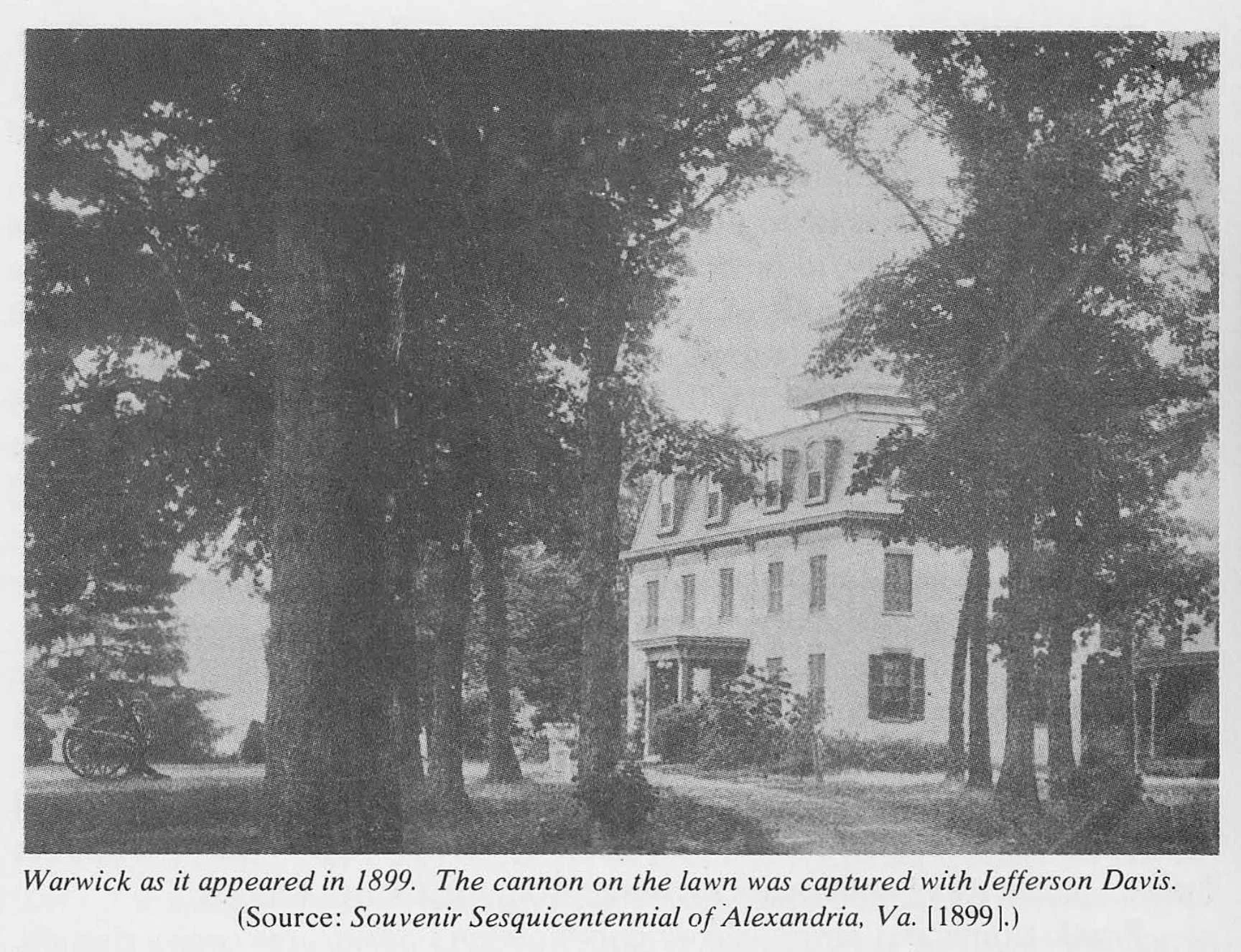
Another portion of Charles Sr.'s land went to his daughter Frances B. Swann. She and her husband William Swann lived at Oakville (see the August 2023 issue of Greet Del Ray), but their son Thomas built Mt. Auburn on the North end of the ridge in the late 1850s. Thomas Swann sold part of his lands to Frank Hume in 1879, who moved into Warwick, located just South of Mt. Auburn.

By the end of the Nineteenth Century, the ridge line was dominated by these four grand estates owned by millionaires. However, the cost of maintaining such homes and the demand for additional housing led to their break up. John Lloyd died in 1871, and his heirs began selling off the Mt. Ida lands to developers around 1908 (see the June 2023 issue of Greet Del Ray). After Frank Hume died in 1906, his widow moved into D.C., leaving Warwick to decay. It was torn down in the early 1950s to make way for Warwick Village. Thomas Swann's granddaughter lived in Mt. Auburn until her death in 1964, after which the house was torn down to make way for the Aspen Apartments.

Northwest Alexandria

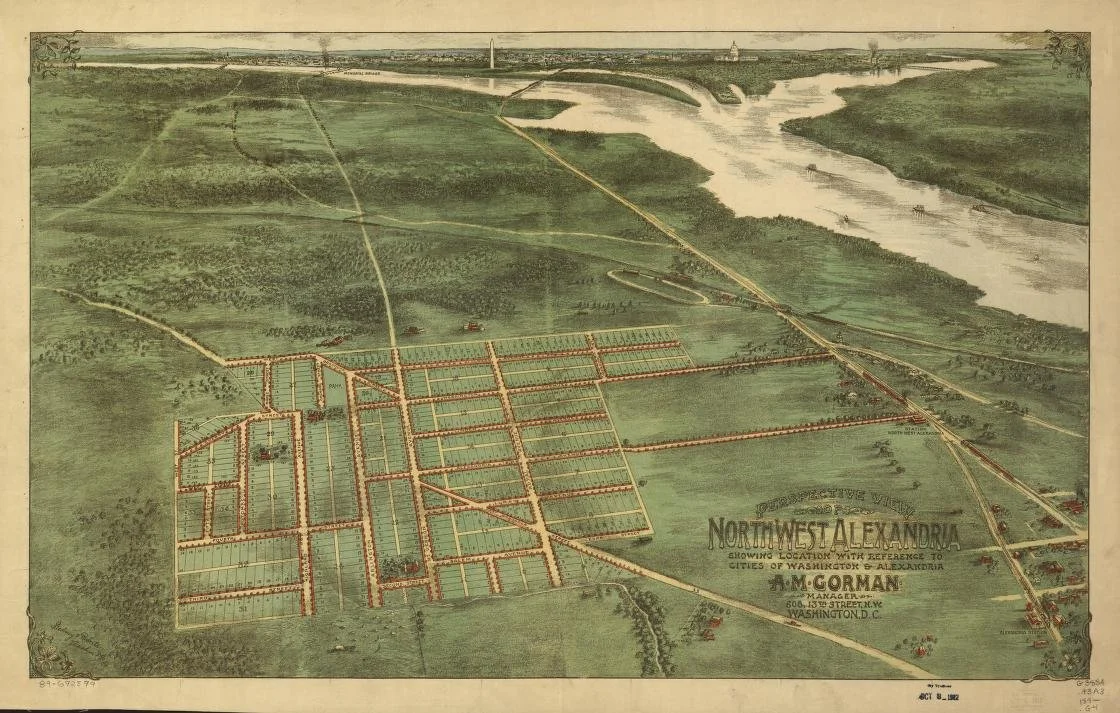
Developers map of the new community of Northwest Alexandria circa 1890. Gedney & Roberts, and A. M Gorman. Perspective view of northwest Alexandria: showing location with reference to cities of Washington & Alexandria. [Washington, D.C.: A.M. Gorman, 189, 1890] Map. https://www.loc.gov/item/89692599/.

Originally published in the October 2023 edition of Greet Del Ray.

One of the original suburbs of Alexandria was located where Del Ray, Rosemont and North Ridge meet today. Almost four years before Del Ray was founded, the Northwest Alexandria Improvement Company began selling lots in their new development, which became known as Braddock Heights. The company advertised the splendid views of Washington, Alexandria and the Potomac River. They also highlighted the planned road from Washington to Mount Vernon and new electric railway passed through the new suburb. Two years later in 1892, the electric railroad opened passing through the new settlement along the path of modern day Commonwealth Avenue. It had two stations within the subdivision to pick up passengers, which made the area an easy commute to jobs in Alexandria and Washington. Despite these conveniences, the lack of utilities such as indoor plumbing cause slow sales, and the company was selling off lots for years.

Sales began in the Northeastern portion of the area, in what is now a part of Del Ray. This area was relatively flatter and easier to build on than the Southwestern part around Timber Branch. The establishment of the electric railroad derailed efforts to create a road to Mount Vernon through the community, and the planned “Mt. Vernon Avenue” was finished as Russell Road. The community of Del Ray was also established to the Northeast with easier access to Richmond Highway, which further slowed sales. However, sewer lines and indoor plumbing came to the area in 1923, leading to additional development in and around Northwest Alexandria. Houses were build lining Alexandria Avenue all the way to Richmond Highway in the Park Addition to Northwest Alexandria. After a contentious battle, the portion of Arlington County south of Four Mile Run was annexed into the City of Alexandria on January 1st, 1930. After annexation, the original developments blurred, and the definition of Del Ray came to include the portions of Northwest Alexandria located East of Russell Road and North of Braddock Road.

Origins of Oakville Triangle

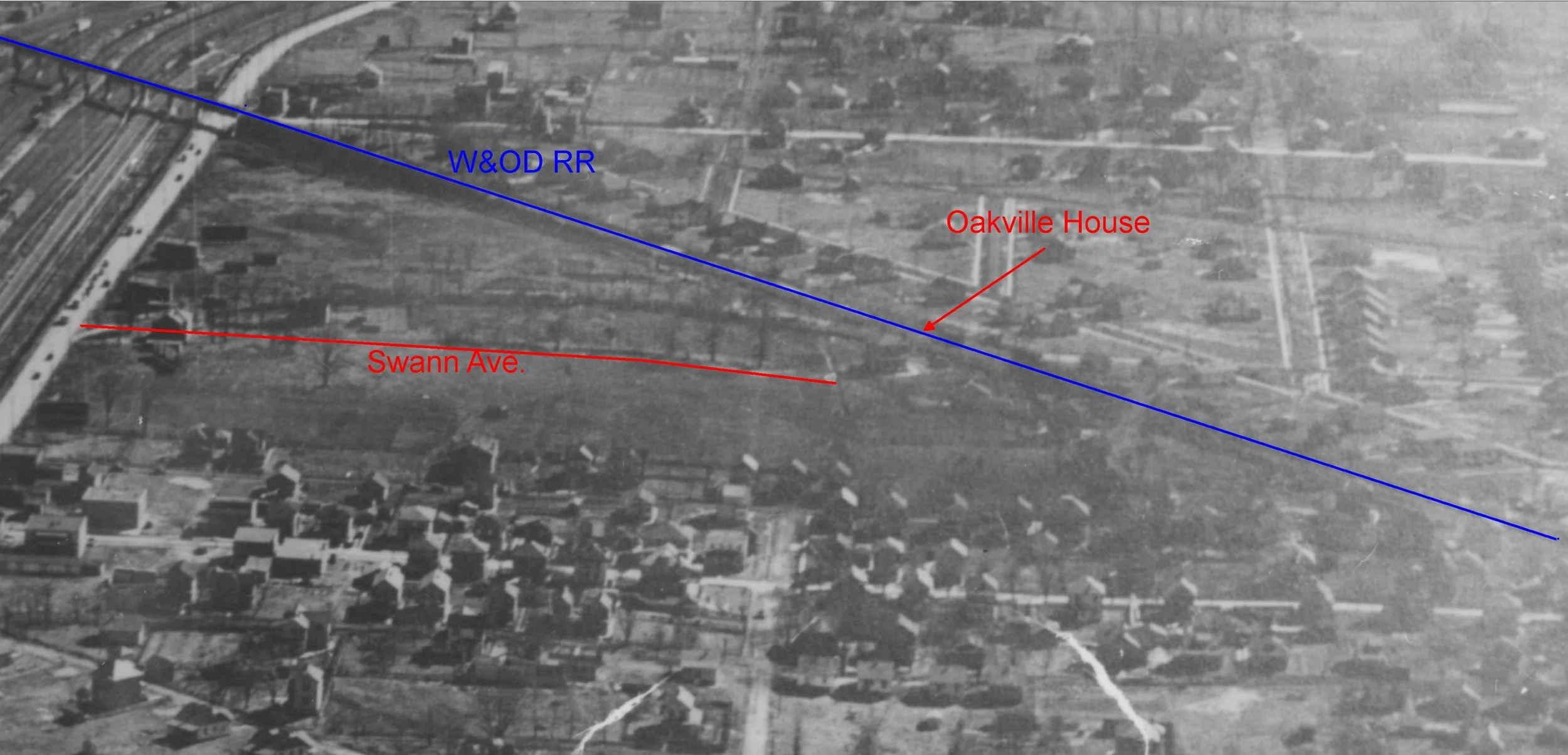
Oakville estate circa 1919 with the tree lined driveway that is now Swann Avenue to the plantation house.

Originally published in the August 2023 edition of Greet Del Ray.

Now that Oakville Triangle is being redeveloped again, it is time to remember its legacy.

William Swann married Frances B. Alexander, the granddaughter of the founder of Alexandria, and inherited “Preston”, the Alexander plantation just north of the original city (located on the new Virginia Tech campus). When their youngest son, Thomas William Swann, married Helen M. Chapman in 1830, they received over 100 acres of land to live and work on. Swann built a home on it and dubbed it “Oakville.” Swann grew primarily hay, rye, oats and corn and had 6 adult slaves in 1860.

In the late 1850s, the predecessor to the Washington & Old Dominion Railroad purchased a right of way through Swann's farm, building their line to Alexandria only about 125 feet from his home. The advent of the railroad prompted Swann to move his family up to the ridgeline which became a popular location for wealthy estates. Thomas built a new home called “Mt. Auburn” situated on the highest point of what is now The Aspen Apartments' parking lot. He retained and continued to farm Oakville for the remainder of his life, and the original plantation house remained. Thomas and Helen both died in 1895, leaving their estate to their only living child, Susan Pearson Alexander Calvert.

Susan's husband, George E. Calvert, was a government clerk, and they were not prepared to continue operating the vast farmland. They began selling off the land. The farm that had been 118 acres in 1860, was less than 60 acres by 1900 and was divided by the new development of St. Elmo. Their land was also divided by the new Mt. Vernon Ave. and the electric trolley line to Washington (now Commonwealth Ave.). After Susan died in 1919, the original Oakville plantation house, which she was born in, was torn down. Her daughter, Helen Calvert inherited the land, and she slowly sold off her estates. The 21.5 acres she owned further south was donated to create the George Washington High School (now a Middle School). The 10 acres of land between Glebe Rd. and Ashby St. became Auburn Gardens Apartments (now Auburn Village Condos). The 15 acres around the original Oakville house was sold off and developed in the early 1960s into Oakville Triangle industrial park.

Origins of the Mount Ida Neighborhood

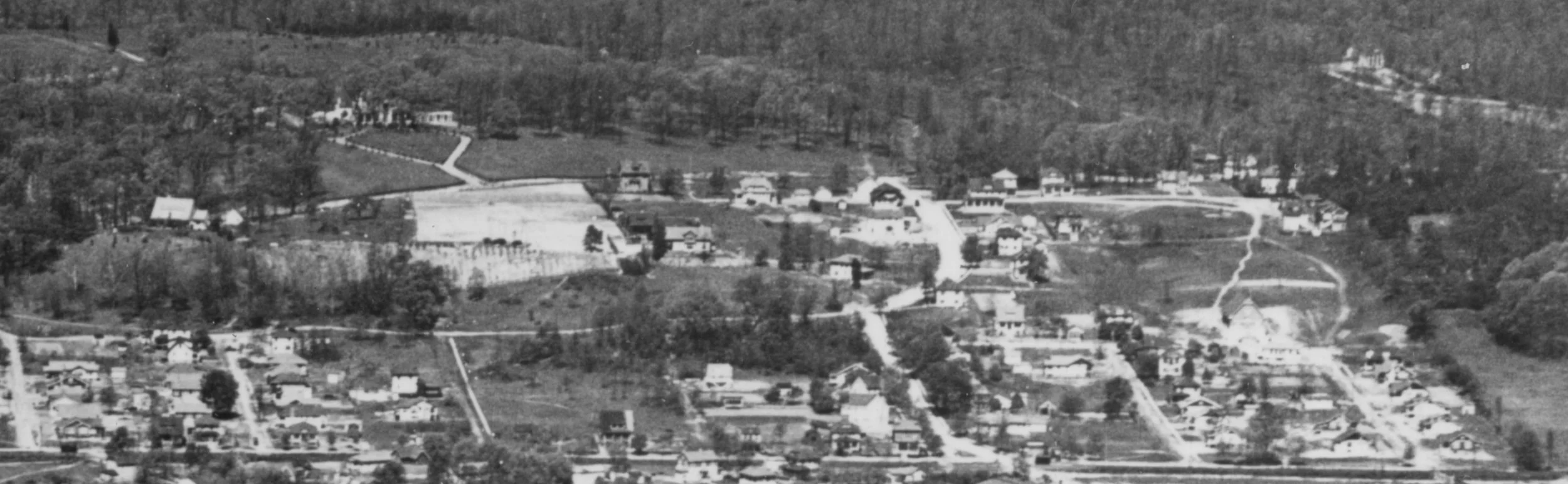
Mount Ida circa 1923.

Originally published in the June 2023 edition of Greet Del Ray.

At the beginning of the 20th Century, the ridge to the west of Russell Road was dotted with homes of wealthy businessmen and land owners. These homes include the Swann/Calvert family home “Mount Auburn” (for which Auburn Village is named), the Hume family home of “Warwick” (for which Warwick Village is named) and the John Lloyd family home “Mount Ida” (for which the Mount Ida development is named). Of these three houses, only “Mount Ida” remains standing at 305 Charles Alexander Court. More information about “Mount Ida” can be found in Daniel Koski-Karrell's 1993 study of the house, which is available on the City's website.

In the early part of the 20th Century, the heirs of John Lloyd began selling off parcels. In 1908, Mr. James S. Groves began acquiring 150 acres of the Lloyd estate and formed the Mount Ida Realty Company. Groves was the President of the Company, and James R. Caton was the Secretary. The company laid out the Mount Ida development bounded by Russell Road, Del Ray Avenue, Commonwealth Avenue and Forrest Avenue/Holly Street/McArthur Road. The initial 14 blocks of Mount Ida were laid out in early 1909 as the Groves Subdivision. In July 1909, the Mount Ida Realty Company completed the purchase of Lot 3 of the estate from George and Nellie Uhler and began laying out an additional subdivision consisting of blocks 15-17 of Mount Ida (between Uhler and Wyatt Aves.). Many of the original streets were named after the Lloyd family (Lloyd Avenue, Woolfolk Avenue, Alexander Avenue, and Uhler Avenue), but several of these street names were changed after the area was annexed into the City of Alexandria.

Once the plats were approved and filed, the company began selling the lots. During this era, developers sold lots, and the purchasers constructed the home. The original subdivision was sold off and developed first, and development of Blocks 15-17 did not start until the 1920s.

The Beginning of Del Ray.

Originally published in the April 2023 edition of Greet Del Ray.

When Charles E. Wood of the real estate development company Wood, Harmon and Company began his first development in Northern Virginia, he needed a location reasonably close to transportation, yet still rural in character. The farms north of Alexandria afforded an excellent opportunity because the transportation lines between Washington and Alexandria crisscrossed this land. In 1894, he purchased two large tracts of land north of Alexandria just off the road and rail lines to Washington.

The first tract of land consisted of 254 acres just south of the St. Asaph Racetrack that had been part of the Lloyd family’s Belmont estate. Wood named this area Del Ray and hired D. J. Howell to survey it into 1160 lots. Standard lots measured 25 feet wide and 115 feet deep. The other tract consisted of 38.68 acres from Frank and Emma Hume that lay between the St. Asaph racetrack and Glebe Road. It was named St. Elmo, and L. H. Hyer surveyed it into 491 lots. Here, standard lots were 25 feet wide and 120 feet deep. Streets were laid out in a grid pattern within the irregular boundaries of the tracts. Wood paid a total of $54,216 for the two tracts of land, and he expected to triple his original investment by selling the lots for between $50 and $150.

St. Elmo was completed first, and Wood began selling lots on 2 April 1894. Jefferson and Emma Ashford purchased two lots to construct the first home in St. Elmo at 301 Clifford Ave. This house was described as a Folk Victorian and was designated a contributory structure to the Town of Potomac National Historical District (Potomac NHD). Unfortunately, it was torn down in 2015.

When Wood began selling lots in Del Ray one month later, it immediately proved more successful. George and Martha Mundell constructed the first house at 208 E. Howell Ave. It is also a contributory structure to the Potomac NHD, which listed it as a c. 1895 Vernacular house. The Mundells purchased a second lot and expanded the original house.

The Forgotten Corps — Inside Patton’s I Armored Corps

THE UNITED STATES deployed a total of 24 army corps overseas during the Second World War; all but one were still active at the end of the conflict. Ironically, the one that was demobilized, I Armored Corps, played a key role in America’s preparations for war. It was also commanded by one of the U.S. Army’s most famous generals: George S. Patton, Jr. The first corps to see action in Europe, I Armored Corps remains largely forgotten today.

For the full story, visit Military History Now.

The Founding of Del Ray

Originally published in the February 2023 edition of Greet Del Ray.

When Lt. William Reatus Harmon (10th Cavalry) passed away in 1886, he left behind his sons William E. and Clifford as orphans. Young William left medical school in Louisville, Kentucky to help support his younger brother by working in their uncle Charles Edric Wood’s store in Lebanon, Ohio. Wood quickly realized that the older Harmon brother was a particularly adept salesman. When William developed a scheme to sell real estate, Charles decided to provide the financial backing, and the three of them formed Wood, Harmon & Company.

William recognized a growing trend in America. Well to do families wanted to move away from the filth and crowds of the city and live in homes comfortably spread apart with a small yard or garden. William planned to buy a large tract of land just outside of a major city and divide it up into individual lots for single family homes. With Charles’ backing, William purchased their first tract of land in 1887, and they developed the subdivision of Branch Hill next to the rail lines northeast of Cincinnati. Their business plan proved wildly successful, and they eventually expanded into one of the biggest real estate companies in the world, with multiple subdivisions in 31 different cities.

Charles E. Wood moved to Washington, D.C., in 1893, and bought tracts of land just outside of Washington and Alexandria. The former he subdivided into the community of Woodmont, which is now a part of Bethesda located just off Wisconsin Ave. The latter he subdivided into the communities of Del Ray and St. Elmo, which went on sale May 5 th , 1894. After succeeding with these communities, Charles bought more land in Virginia and created the subdivision of Clarendon in 1900. Charles permanently resettled to Washington, D.C. and became involved in a variety of business ventures, included a highly publicized 1906 plan to build the new luxury hotel across the street from the Willard Hotel. Although this plan never materialized, Charles continued to be a successful businessman, serving on the board of directors for several companies and financial institutions. Charles and his wife Eurnie lived comfortably at 2031 Florida Ave, NW until his death on February 17 th , 1908.

Jefferson District and Annexations by the City of Alexandria

The District of Columbia Organic Act of 1801 created two counties with the District of Columbia:  Washington County on the east side of the Potomac River and Alexandria County on the west side.  A variety of poltical maneuvering led to retrocession of Alexandria County back to Virginia in 1846.  After the Civil War, Virginia adopted the Underwood Constitution of 1869, which created magisterial districts within each county.  Alexandria County had three districts:  Washington District was roughly the area north of I-66;  Jefferson District was roughly the area south of Arlington Cemetary and I-395; and Arlington District was in the center of the county.

The new Virginia constitution also allowed cities over 10,000 people to cede from the county and become independent.  Alexandria City promptly took advantage of this clause and ceded from Alexandria County in 1870, taking away the southern tip of Jefferson District.  The subsequent tension and confusion between Alexandria City and Alexandria County led to the latter changing its name to Arlington County in 1920.   

In the late 1890s, Jefferson District began filling in with suburbs of Alexandria, such as Del Ray and St. Elmo (which became the Town of Potomac), Rosemont, Braddock Heights, Mt. Ida, George Washington Park and North Alexandria.  As most of the population in these suburbs worked in or had other ties to Alexandria City, the city began annexing these areas in the early 20th Century.  In 1915, the first annexation trimmed more off the southern end of Jefferson District, absorbing Rosemont and parts of Braddock Heights by pushing the western boundry of the city from West Street out to the foot of Ivy Hill.  During the 1920s, Alexandria successfully lobbied to extend its northern border, and on January 1st, 1930, the area of Jefferson District south of Four Mile Run was also annexed into the City of Alexandria.

Arlington County leaders fought to avoid this annexation.  Among other efforts, they successfully pursued an amendment to the Virginia Constitution in 1928, which allowed alternative forms of county government.  Once this amendement was passed, they sought legislature which allowed Arlington to assume a County Manager form of government, much like a city government.  Arlington County adopted this form of government in 1932, abolishing the magisterial districts within the county.  Although too late to stave off the annexation of most of Jefferson District, the new form of government effectively blocked further annexation by eliminating the ability of a magisterial district to vote independently of the rest of the county.  Arlignton County officials publicly touted this change as a means to "safeguard Arlington County from further annexation by the City of Alexandria."